
The Gobi is not the desert people imagine. One may think of endless golden sand and towering dunes. But the Gobi is different. Most of this enormous desert is filled with rubble, breezes, parched channels, and void pads. Some areas have mountains too. Spanning the southernmost parts of Mongolia and the northernmost reaches of China, it forms one of Asia’s most unique landscapes. As if the Gobi holds something special. It appears quiet, but it is never really bare.
A Desert With a Wild Personality
You do not have to walk around the Gobi for long before you learn that nature does not provide a single template. And one second, you might be looking at miles of rocky plain disappearing over the horizon. Next, a mountain range shows up in the background. Grass covers another parched area of the valley. The landscape keeps changing. And that is what makes the Gobi Desert so interesting. It defies any single, simplistic image of a desert. It makes the place seem uninhabited, even with this capture in it. And the Gobi also disproves that idea.
The Gobi Desert Can Be Surprisingly Cold
We all know that deserts can’t be cold. It’s summer in the Gobi. The Gobi is another story. Nights can be a big difference from days. It is more than just finding shade to survive the heat of the desert. Animals and humans face heat, cold, air currents, and a deficit of water. Gobi life is a slow one and requires preparation. Weirdly, the weather’s what makes the desert characterful. You can never feel too comfortable.
Bactrian Camels: Built for the Gobi
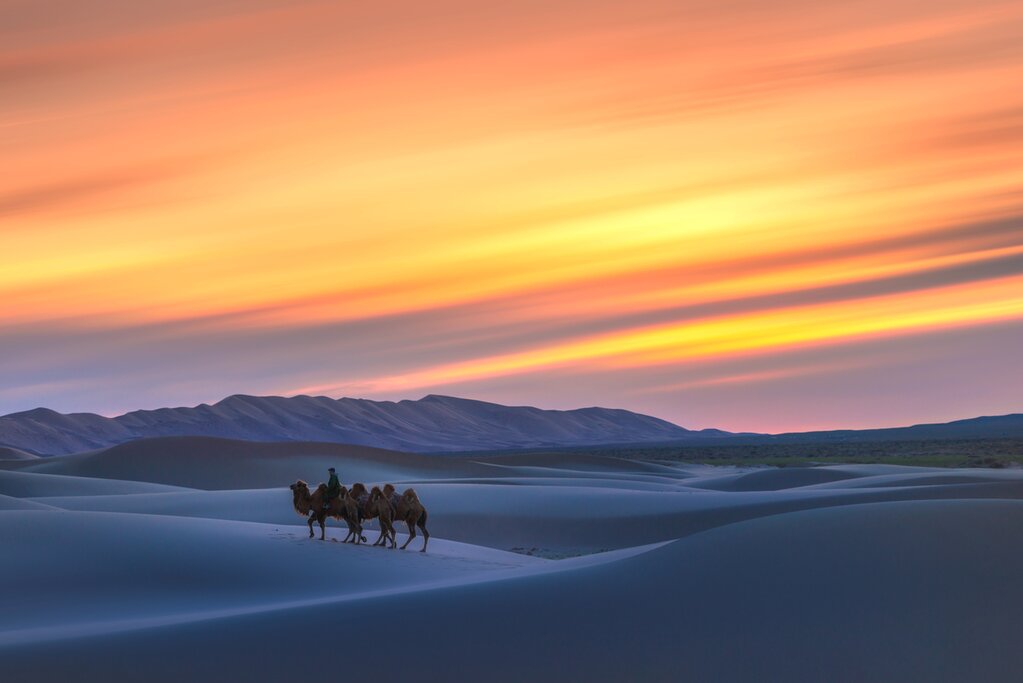
No desert-dwelling animal seems to possess as much individuality as the Bactrian camel, and this was also the case in the Gobi. The two-humped camel (Bactrian) is different from the one-humped Arabian camel. A hump is placed on each side of the animal’s torso. This animal deserves admiration even more than the one-humped camel because it is used for transport and for carrying heavy loads even now, although it has been domesticated in the meantime. It is really a pleasure to see how camels travel across long distances in the Gobi, and to admire these animals that are so intrinsically linked to the vast wilderness of the Gobi.
A Dinosaur Museum Without Walls
Another amazing secret of the Gobi is its widespread fossils. In the Gobi, all these remains, the likes of dinosaurs’ bones, eggs, nests, etc found help scientists study the creatures that once inhabited it. Try to realize this: a wasteland so deserted today had meat-eating monsters roaming about 70 million years ago! It is this that transforms Gobi into an open living history book.
Life Finds a Way
Rainfall in the Gobi is a rare thing, but still plants exist. Where conditions permit, small grasses, shrubs, and other foliage grow. The way they are rooted and grown helps them to withstand water shortages. These plants may look ordinary. They are not. A scrap of grass is food for an animal living in the Gobi. Good pasture can make a world of difference for a family raising livestock. In a desert, every small piece of life counts.
People Call the Gobi Home
The Gobi is more than just a wildlife playground and fossil destination, however. People live there too. In Mongolia, herders have raised goats, sheep, horses, cattle, and camels for centuries. Conditions on land and weather are critical to their living. They learned things that a visitor may never realize. They know where any animals can graze. They understand seasonal changes. They sit, and they stare at the sky and at the weather. This knowledge is transferred from one generation to another. The land, in a sense, becomes your educator.
The Gobi Is Not Completely Silent
If you stand in an open stretch of the desert, you will find something strange: there are fewer sounds. No constant traffic. No crowded streets. No busy shops. Rather, you hear wind traveling across the countryside. The silence may seem foreign at first. With time, it can be quite soothing. Maybe that is also a reason why we remember the Gobi so strongly. Today, our lives consist of noise, notifications, engines, and conversations. The desert washes away a lot of that. It simply opens space in your brain.
Why the Gobi Needs Protection
The Gobi Desert is a very beautiful place, but an existence with wildlife requires far greater space for adequate food, water, and shelter; pulverizing what seems to be the open, sparse, and empty landscape we see almost convinces us otherwise. Climate change, mining, and roads put pressure on this ecosystem and the biodiversity of the natural resources of the region. The problem is of particular importance for species with low populations, such as snow leopards; these wild cats need large territories to survive. The Gobi Desert is a complex problem in terms of wildlife and people conservation. Additionally, the Gobi Desert is home to the local population; hence, its conservation must be environmentally friendly yet people-centred.
What Makes the Gobi Different?
The most surprising thing about the Gobi Desert. Desert it is, but a desert of more than just sand. Dry, yes, but life still grows. It is brutal, but this is what they call home. Empty but full, millions of years trapped inside. It is that contrast which gives the Gobi its particular character. The best case is that you could look at hundreds of photographs and still be blind to something. Real experience is understanding how many different stories there are to be told in that same landscape.
Discontinuation
The Gobi Desert offers a straightforward lesson. Life does not always require perfect weather. A camel survives the cold. A plant waits for rain. A herder follows the seasons. A fossil spends millions of years buried until someone finds it. Each story is different. But they all share one thought: adaptability counts. And perhaps that true splendour of the Gobi. It is not attention-seeking. It just is, vast and robust beneath the sky. And maybe that is why the Gobi stays there long after you have closed the book on it.